
Side events for the exhibition

Tours with food & drink
Breakfast & Art
offers a more in-depth, special morning visit to the exhibition with an experienced colleague from our Education team. Afterwards, you will receive further insights into Whistler’s and Masuyama’s art over an international breakfast selection.
April 30 / May 6 / May 15 / May 19 / May 27 / May 29 / June 3 / June 11 / June 16 / June 17 / June 18 / June 25 / July 1 / July 2 / July 3
as well as every Saturday, 10 AM–12 PM
€25 (incl. breakfast)
Unfortunately already over

Coffee Time & Art
offers a more in-depth, special afternoon visit to the exhibition with an experienced colleague from our Education team. Over coffee and cake, you will then receive further insights into Whistler’s and Masuyama’s art.
April 28 / May 7 / May 22 / June 5 / June 16 / June 26
2:30 PM to 4:30 PM
€20 (incl. drinks & cake)
Unfortunately already over
After Work Art
is an evening visit to the exhibition with an experienced colleague from our Education team. Enjoy wine and finger food as you round off the evening.
May 5 / May 26 / June 23
5–7 pm
€25
Unfortunately already over
4 Rooms – 4 Works – 4 Wines
is a special experience in which four works from four rooms are presented in more detail during an exhibition tour of around 45 minutes. Afterwards, a wine tasting with four delicious Ingelheim wines and four tapas will take place in the vinotheque of the Ingelheim Winzerkeller.
May 29
6–8:30 pm
€35
Unfortunately already over
Public Tours
Important: The tours take place outside regular opening hours, which is why the rooms are no longer accessible on Thursdays and Saturdays after the tour. However, your ticket entitles you to visit the exhibition before the tour.
If your reservation is successful, you will receive a confirmation email. Please also check your spam folder.
Online registration is required.
Thursday 6:30 pm
Saturday 5 pm
Sundays and public holidays 10 am
Duration: approx. 60 min.
€5 plus €8 admission (€6 reduced)
Unfortunately already over
Curator-led tours
Curator’s Tour
Together with the curator, you will discover and explore selected exhibits by Whistler and Masuyama, learn interesting details about how the exhibition came about, and what special considerations had to be taken from the initial concept through to opening. Further questions will then be discussed over a glass of wine.
With Dr Katharina Henkel, Curator
Tue, April 28, 4:30 PM / Tue, May 12, 5 PM / Wed, May 20, 4:30 PM / Thu, June 25, 5:30 PM / Tue, June 30, 6:00 PM
approx. 2 hours each
€20
Unfortunately already over
Art in & Lunch to go
The curator will introduce four of her favourite works by Whistler and Masuyama—briefly and to the point. To refuel, all participants will then receive a “lunch to go” with a sandwich, water, and fruit.
With Dr Katharina Henkel, Curator
Wed, 13 May / Thu, 11 June
12:30–1 pm each
€12 (incl. lunch bag)
Unfortunately already over
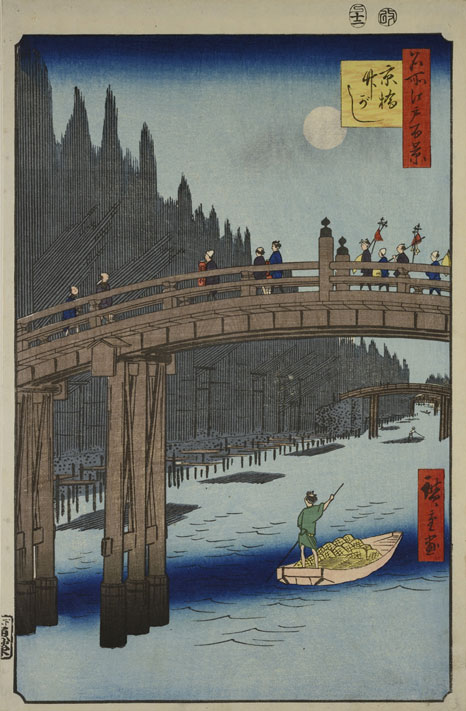
Talk and a look behind the scenes
Tip! With your ticket you can visit the exhibition before the talks. From 6 pm, Room 3 will have restricted access in preparation for the talks.
“From cradle to grave, life is a transport problem”
From the daily work of an art inspector
Unnoticed by laypeople, extremely elaborate art transports are repeatedly carried out for exhibitions. To ensure that the exhibits arrive undamaged at their destination, many aspects must be considered during planning: How are fragile paintings, the Blue Mauritius, or delicate glass objects packed? And how can gigantic steel sculptures, antique terracotta figures, or the mask of Tutankhamun be transported in the best possible way? The evening offers highly fascinating behind-the-scenes insights into exhibition venues and their sometimes spectacular art transports.
Matthias Szarata is an art inspector at the Hasenkamp fine art shipping company and has been contributing his impressive expertise to the company for 60 years.
Wed, 24 June, 7–8:30 pm
€16 (exhibition visit included until 6:30 pm on this day)
Unfortunately already over
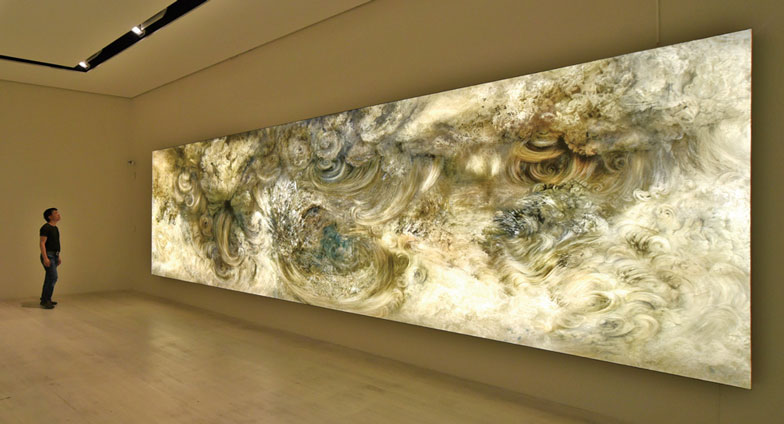
Whistler’s Finest Prints from Venice
“Whistler on the Bridge of Sighs”
Whistler’s Nocturnes paintings from Venice are world-famous, but his graphic series also created in the lagoon city are less well known. Yet these sheets rank among the masterpieces of the Etching Revival—a renaissance of the graphic arts at the end of the 19th century—and in turn inspired Alfred Stieglitz, one of the most important photographers of modernity, to create his iconic images of the city on the water.
The talk traces the defining influences on Whistler’s Venice prints as well as his impact on other artists.
Dr Stefan Trinks heads the arts section of the Frankfurter Allgemeine Zeitung (F.A.Z.) and is a private lecturer in art history at Humboldt University of Berlin.
Sun, 28 June, 5–6:30 pm
€16 (exhibition visit included until 6 pm on this day)
Unfortunately already over
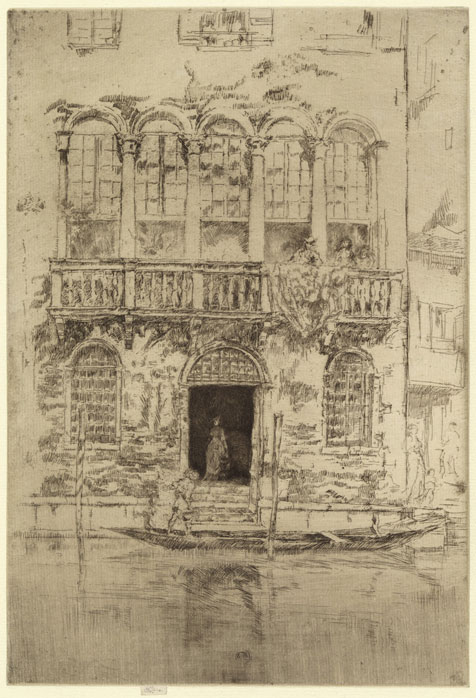
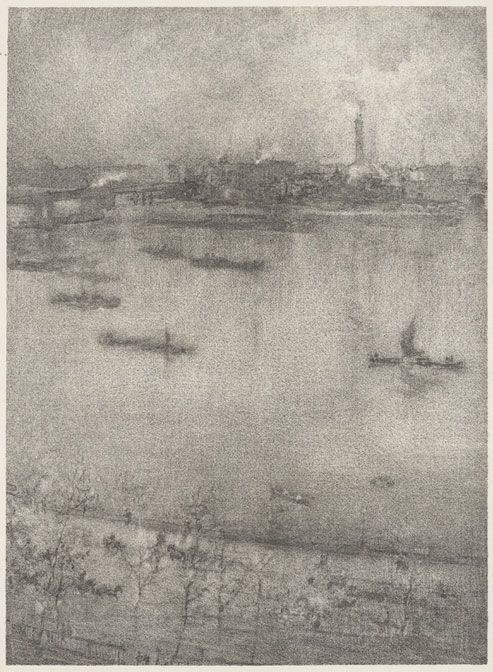
Expert tours
“James McNeill Whistler and his printmaking work”
The American painter, draughtsman, and printmaker Whistler, with his penchant for an eccentric lifestyle, always wanted to define for himself what it means to be an artist. With his paintings, etchings, and lithographs, he is regarded as a pioneer of new and innovative artistic techniques and created remarkable visions of modernity in London, Paris, and Venice. As one of the most influential artists of the 19th century, this not only earned him a prominent place, but also made him an important trailblazer for the art of the 20th century.
Dr Andreas Stolzenburg is Head of the Prints and Drawings Department at the Hamburger Kunsthalle and an expert on the 19th century.
Sun, 26 April, 10:30 am–12 noon
€16
Unfortunately already over
“Of Cold Needles and Lithographic Limestone”
The printmaking techniques of James McNeill Whistler
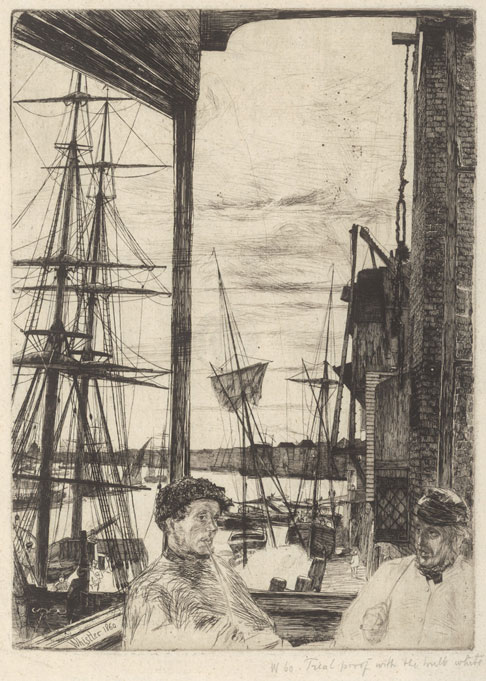
For his graphic work, Whistler preferred etching and lithography. During the tour, you will not only learn more about both processes through selected examples, but also experience a live demonstration of these two printing techniques.
Dominik Gußmann is Head of the Print Workshop at the Haus der Stadtgeschichte in Offenbach am Main and a specialist in etching and lithography.
Sat, May 16, 3:30–5 PM / Tue, June 9, 5–6:30 PM
€16
Unfortunately already over
Workshop
Have you always wanted to produce your own etching, from the preliminary drawing to the printed sheet? Then take part in our workshop!
“Scratched Traces”
A taster course on the etching technique
This one-day workshop teaches the fundamentals of etching and how to handle the materials, the printing plate, and the etching needle. After creating a small sketch, it is transferred to the metal plate and printed on paper as a hand pull. An interest in drawing and printmaking is an advantage.
Please bring your own apron; your own printmaking tools may of course be used.
Printing plates and etching needles, as well as paper and ink, will be provided.
With a member of our Education team.
Fri, May 15 / Sun, June 14 / Sun, June 21
10 AM–5 PM each
(Number of participants: min. 8, max. 12 people)
€60, incl. materials, excl. catering
Unfortunately already over
Day & Night of Art
“Day & Night of Art”
Family time & cultural experience
This year, the Internationale Tage are turning day into night of art. For the first time, the festival will take place from 11 AM to 11 PM, but as usual at the Kunstforum Ingelheim – Altes Rathaus and on François-Lachenal-Platz! An exciting program awaits all culture enthusiasts of all ages:
From 11 AM, the exhibition “From London to Venice. Whistler & Masuyama” opens with free guided tours for adults starting at 11:30 AM. At 2 PM, a fantastic indoor and outdoor program for children begins: with child-friendly tours through the exhibition followed by workshops where participants playfully and experimentally develop their own visions of living spaces with silhouettes of the cities of London and Venice. The multi-layered montages can be taken home, as can the Japanese-style fans created in the outdoor area.
“Monsters – Münster – Adventures” takes place from 3 PM to 6 PM in the courtyard of the Museum bei der Kaiserpfalz: Together with the Forschungsstelle Kaiserpfalz, the museum offers many activities as a family program: imaginative stick animals, monster pins, or travel memory booklets are crafted. During a digital scavenger hunt through the Kaiserpfalz, all treasure hunters can discover many exciting details that remain hidden from most other visitors.
To satisfy small appetites, delicious snacks such as pretzels, hot dogs, popcorn, or donuts will be offered from 11 AM at the café in the Altes Rathaus and on the square. At 6 PM, the traditional “Nacht der Kunst” begins with live music from the “Engel-Trio” accompanied by delicious dishes from Boehringer Ingelheim’s catering services, as well as cocktails and Ingelheim wines. From 6:30 PM, short guided tours of our exhibition take place every hour.
The Museum bei der Kaiserpfalz offers flashlight tours, and guided tours also take place in the atmospherically illuminated archaeological zone Kaiserpfalz.

More information about the program can be found on-site on June 12.